

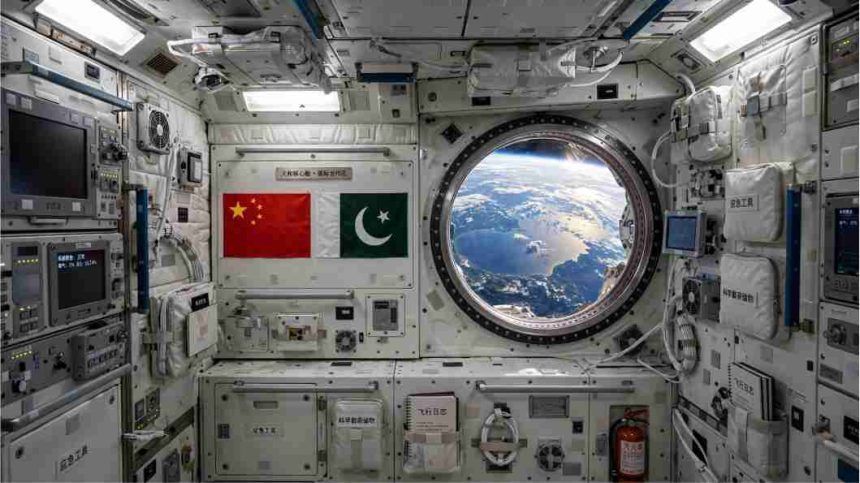
Pakistan Prepares for Historic Manned Spaceflight Aboard China’s Tiangong
Pakistan is on the verge of entering the era of human spaceflight. At China’s Astronaut Research and Training Centre in Beijing, two Pakistan Air Force pilots – Muhammad Zeeshan Ali and Khurram Daud – are undergoing rigorous astronaut training. One of them will soon create history as the first Pakistani in space and the first foreign national to work aboard the Chinese Tiangong space station.
According to sources, the final crew selection is scheduled for mid to late October 2026 (PST).
The selected astronaut will fly as a payload specialist. Unlike a mission commander who flies the spacecraft, a payload specialist is primarily responsible for executing scientific research in orbit. The Pakistani astronaut will be tasked with operating a series of experiments developed by Pakistan.
The two candidates were shortlisted from a competitive pool of around 20 finalists, which included both pilots and scientists from across the country. The selection process went beyond standard medical and psychological evaluations, placing strong emphasis on the ability to withstand extreme g-forces during launch and re-entry – a key reason why pilots were preferred.
The training curriculum is demanding. It includes intensive Mandarin language courses, as all spacecraft operations and communications are conducted in Chinese, along with in-depth study of Tiangong’s systems, emergency procedures, and adaptation to microgravity. The officers have spent months in centrifuge training, language immersion, and simulations for living and working in zero gravity.
Amer Gilani, who is managing the human spaceflight collaboration at SUPARCO, stated that the decision to select pilots was strategic. Most research scientists, he noted, do not have the physical conditioning needed to endure the stresses of crewed flight.
The upcoming mission is planned to last approximately seven days. For this short-duration flight, Pakistani universities from Karachi, Lahore, and Islamabad submitted over 300 research proposals. Four experiments in the field of biotechnology were finally selected, focusing on critical issues like food security and climate change.
All four payloads were developed and tested at SUPARCO facilities before being cleared by Chinese engineers – a significant validation of Pakistan’s indigenous scientific capabilities on a global platform.
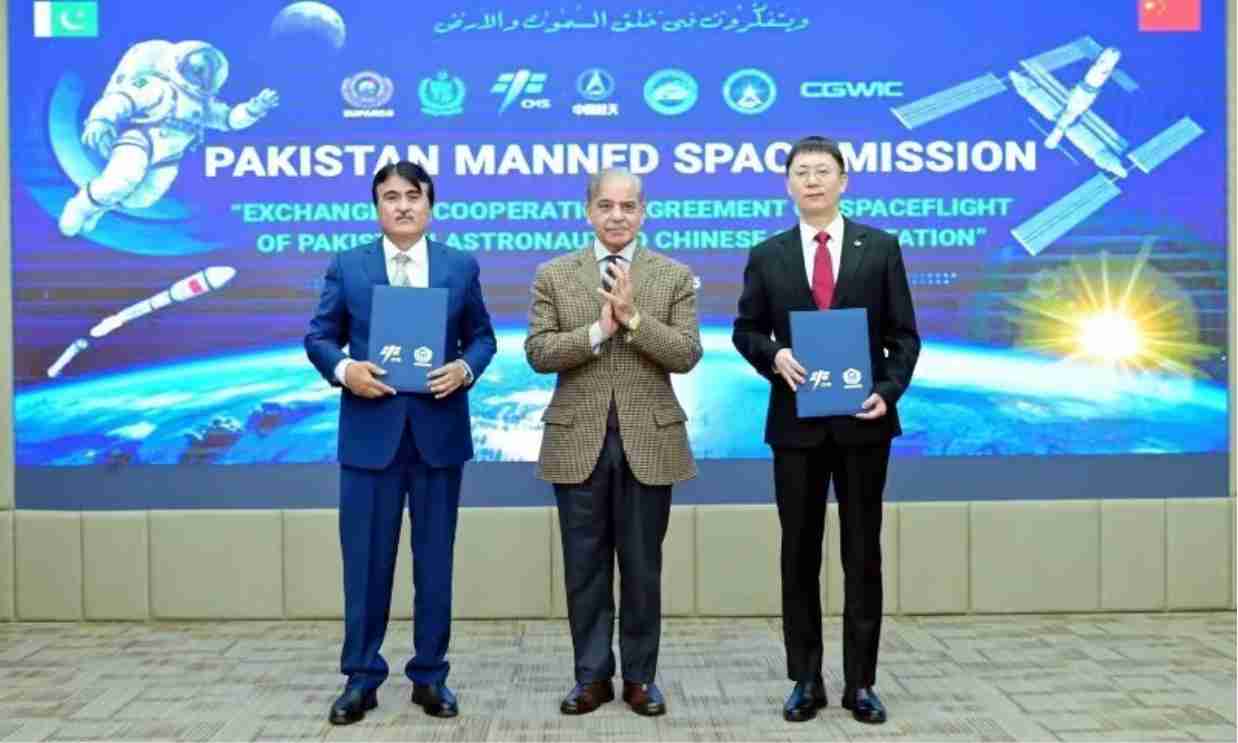
This milestone is the result of a long-term partnership that began in 2019. The collaboration was formalized in February 2025 when SUPARCO and the China Manned Space Agency (CMSA) signed an agreement for astronaut training, which was reaffirmed in May 2026. The cooperation extends beyond human spaceflight to satellite launches, joint navigation systems, and a Pakistani-made rover that is expected to be part of China’s Chang’e 8 lunar mission in 2028.
The Tiangong station itself consists of three modules – Tianhe, Wentian, and Mengtian – weighing about 77 tons collectively and equipped with around 14 scientific racks. To date, it has supported over 180 experiments, resulting in more than 500 publications and 150 patents
While Pakistan’s contribution is small in size, its impact is historic. It will not only mark the country’s debut in crewed space exploration but also prove that Pakistani science can meet the stringent standards of an international space station.
The astronaut will launch aboard a Chinese spacecraft from a Chinese launch site, under the full supervision of Chinese instructors. While Pakistan currently lacks its own crewed launch vehicle, this joint mission is seen as a crucial foundation for building expertise for future independent space ventures.