




By Wang Yunshan, People’s Daily
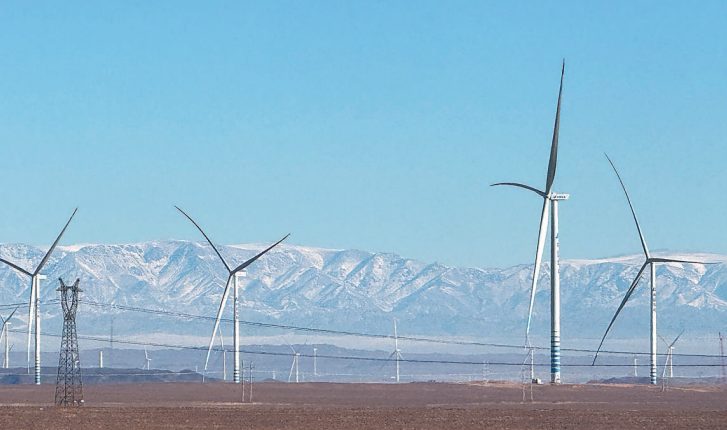
In Santanghu township, Hami, northwest China’s Xinjiang Uygur autonomous region, rows of wind turbines, each towering over 100 meters, stand across the vast Gobi Desert. Beneath them, a vast sea of dark photovoltaic panels stretches.

This is China’s first large-scale renewable energy base with outbound transmission project in desertified areas—the Tianshan North Slope Gobi Energy Base, which also serves as a supporting power source for the “Xinjiang-to-Chongqing” ultra high voltage (UHV) transmission project. More than 70 percent of its installed capacity comes from renewable energy. The project is now sprinting toward full-capacity grid connection.
Desertified areas typically possess abundant wind and solar resources, along with vast tracts of land suitable for large-scale development.
Take Hami as an example. Of its 142,100 square kilometers of territory, 94,600 square kilometers are Gobi, accounting for 66.57 percent of the total area. This provides extensive underutilized land ideal for scaling up renewable energy projects.
Hami also sits within a high-wind belt, experiencing nearly 200 days of winds stronger than Force 8 each year. With 3,100 to 3,300 hours of annual sunshine, it is among the sunniest regions in China.
Construction of the Tianshan North Slope Gobi Energy Base officially began on Feb. 26, 2024. Covering about 1,651 square kilometers, the base will have a total installed capacity of 14.2 million kilowatts.
“The project adopts an integrated model of wind, solar, thermal and storage, allowing multiple energy sources and storage technologies to complement one another,” said Liu Yongqing, director of the engineering and materials department at Xinjiang Huadian Tianshan Power Generation Co., Ltd. When one energy source is affected by weather or other conditions, others can compensate, while thermal power and energy storage provide flexible adjustment to ensure a stable, continuous energy supply and support large-scale renewable transmission.
According to Chang Jiaxing, general manager of Huadian Xinjiang Power Co., Ltd., once the 8.1-million-kilowatt project led by the company is completed, it will generate an additional 14.2 billion kilowatt-hours of green electricity annually, saving 4.27 million tons of standard coal and reducing carbon dioxide emissions by 11.72 million tons. This will help fully leverage Xinjiang’s resource advantages and accelerate the transition toward clean, low-carbon energy.
When the Tianshan North Slope Gobi Energy Base becomes fully operational, it will deliver 36 billion kilowatt-hours of green electricity each year through a Hami-Chongqing ±800 kilovolt UHV transmission line to Sichuan and Chongqing, transforming what was once a barren expanse into an “energy oasis.”
However, desertified areas face extreme weather and fragile ecosystems. Renewable energy, by nature intermittent and variable, can pose challenges to the stable operation of the power system. How are these challenges addressed?
More than 100 kilometers away, construction is in full swing at a 2×1-million-kilowatt coal-fired project, developed as a regulating power source for the base.
“The two coal-fired units are designed for peak regulation and can generate up to 10 billion kilowatt-hours of electricity annually,” said Lu Gang, general manager of Huadian Tianshan Green Energy Co., Ltd. Under safe operating conditions, each unit can reduce output to as low as 20 percent of its rated capacity, enabling coal power to serve as a flexible stabilizer.
In practice, when wind and solar generation surge, the coal-fired units automatically scale back to make room for clean energy. When wind and solar output drops, the units ramp up promptly, ensuring that power continues to flow through the transmission corridor.
Efficiency is a defining principle of construction and operation across the base. Inside an integrated control center for the coal-fired project, a five-meter screen displays real-time operation data. “Unlike a typical coal plant control room, this one can control and dispatch both renewable and coal-fired units simultaneously,” said Zhang Mingjie, an executive of Xinjiang Huadian Tianshan Power Generation Co., Ltd. Using large AI models, the system automatically calculates the optimal generation mix when dispatch instructions are issued. With the help of this system, the base’s renewable energy absorption capacity is expected to increase by around 3 percent.
“Through ongoing technological upgrades, the base has achieved lower coal consumption for power generation, reduced auxiliary power use and higher main steam pressure. This ensures a stable supply of green electricity while helping solve key technical challenges in developing renewable energy in the Gobi desert,” said Yang Jinfa, general manager of Xinjiang Huadian Tianshan Power Generation Co., Ltd. “The project offers a replicable model for the construction of future renewable energy bases in desertified areas and for advancing China’s new power system.”