

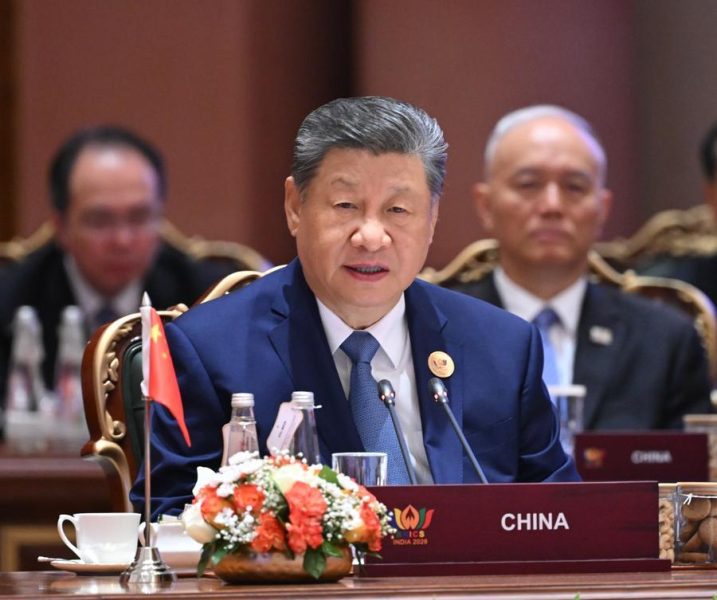
Chinese President Xi Jinping on Saturday urged BRICS countries to firmly stand on the right side of history and strive to be a pioneer of our times.
When addressing the 18th BRICS Summit in New Delhi, Xi noted that this year marks the 20th anniversary of BRICS cooperation, saying the mechanism has become the world’s most influential platform for cooperation among emerging markets and developing countries.
Over the past two decades, BRICS has evolved into a broader platform for promoting shared growth, dialogue, and a greater representation of the Global South in international organizations, said analysts, noting that the group is expected to deliver more tangible results and foster a more balanced and inclusive world order in the future.
TWO DECADES OF BRICS COOPERATION
The BRICS cooperation mechanism was formally launched in 2006. The inaugural BRIC summit was convened in Yekaterinburg, Russia, in 2009. A year later, South Africa joined the grouping, turning BRIC into BRICS.
Since then, the mechanism has continued to expand in both membership and areas of cooperation. Today, BRICS countries account for nearly half of the world’s population, around 30 percent of the global economy and one-fifth of global trade, serving as a force for fostering a more representative and multipolar world and enhancing the voice of the Global South.
Hailing the achievements over the past two decades, Xi said that the BRICS cooperation mechanism has continued to grow and expand, and has demonstrated remarkable vitality and dynamism.
Elaborating on the 20-year history of the mechanism, Xi said it has been 20 years of self-reliance and self-strengthening, adding that BRICS countries have actively explored development paths suited to their own national conditions, setting an example of self-strengthening through unity among emerging markets and developing countries.
The first decade of BRICS cooperation was primarily a period of institutional formation, and the second a period of expansion, said Rakhim Oshakbayev, director of the TALAP Center for Applied Research in Kazakhstan and former Kazakh vice minister for investment and development.
But the significance of BRICS goes beyond the growth of its membership.
Xi said that BRICS countries have established a comprehensive, multi-tiered framework for cooperation, and ushered in a new stage of high-quality development for greater BRICS cooperation.
Rather than replacing existing global institutions, BRICS seeks to strengthen dialogue, equality, mutual respect and cooperation among nations, said Balew Demissie, a senior consultant at the Policy Studies Institute of Ethiopia.
BRICS, with its expanded membership, provides a platform for emerging economies across the globe to have a stronger voice in global issues such as trade, development, finance, climate change, peace and security, Demissie said.